Sunday, February 27, 2011

20 predictions for the next 25 years
The Guardian has put together an interesting list of predictions for the next 25 years:
– Geopolitics: 'Rivals will take greater risks against the US'
– UK economy: 'The popular revolt against bankers will become impossible to resist'
– Global development: 'A vaccine will rid the world of Aids'
– Energy: 'Returning to a world that relies on muscle power is not an option'
– Advertising: 'All sorts of things will just be sold in plain packages'
– Neuroscience: 'We'll be able to plug information streams directly into the cortex'
– Physics: 'Within a decade, we'll know what dark matter is'
– Food: 'Russia will become a global food superpower'
– Nanotechnology: 'Privacy will be a quaint obsession'
– Gaming: 'We'll play games to solve problems'
– Web/internet: 'Quantum computing is the future'
– Fashion: 'Technology creates smarter clothes'
– Nature: 'We'll redefine the wild'
– Architecture: What constitutes a 'city' will change
– Sport: 'Broadcasts will use holograms'
– Transport: 'There will be more automated cars'
– Health: 'We'll feel less healthy'
– Religion: 'Secularists will flatter to deceive'
– Theatre: 'Cuts could force a new political fringe'
– Storytelling: 'Eventually there'll be a Twitter classic'
– Geopolitics: 'Rivals will take greater risks against the US'
– UK economy: 'The popular revolt against bankers will become impossible to resist'
– Global development: 'A vaccine will rid the world of Aids'
– Energy: 'Returning to a world that relies on muscle power is not an option'
– Advertising: 'All sorts of things will just be sold in plain packages'
– Neuroscience: 'We'll be able to plug information streams directly into the cortex'
– Physics: 'Within a decade, we'll know what dark matter is'
– Food: 'Russia will become a global food superpower'
– Nanotechnology: 'Privacy will be a quaint obsession'
– Gaming: 'We'll play games to solve problems'
– Web/internet: 'Quantum computing is the future'
– Fashion: 'Technology creates smarter clothes'
– Nature: 'We'll redefine the wild'
– Architecture: What constitutes a 'city' will change
– Sport: 'Broadcasts will use holograms'
– Transport: 'There will be more automated cars'
– Health: 'We'll feel less healthy'
– Religion: 'Secularists will flatter to deceive'
– Theatre: 'Cuts could force a new political fringe'
– Storytelling: 'Eventually there'll be a Twitter classic'
Saturday, February 26, 2011
Supposed to be researching fairy tales...
The Exposure Project
SATURDAY, FEBRUARY 27, 2010
Angela Strassheim's Evidence
Angela Strassheim's project Evidence hybridizes aspects of criminology and photography into an eerie, often visually savage body of work. In the press release for her recent exhibition at Marvelli Gallery, it states:
"Long after the struggles ended in these spaces, despite the cleaning, repainting and subsequent re-habitation of the rooms, the "Blue Star" solution is capable of activating the physical memory of blood through its contact with remaining proteins on the walls. Long exposures- from ten minutes to one hour- with minimal ambient night light pouring in from the crevices of windows and doors, capture the physical presence of blood as a lurid glow: a constellation of stars embedded in the walls.
Through a long and painstaking research process, Angela mapped out the exact locations where violent, often horrific crimes were perpetrated. She convinced new owners and tenants, some unaware of the violent history of their residences, to revisit the unnoticed, unseen past. Angela captures the tracing of a final struggle through the hard evidence of a violent moment, thereby revealing the silent yet omniscient memory of everyday living spaces. The physical result of her work is a series of luscious, large black and white prints, which attract the viewer like stills from a film noir with their eerie seduction and mysterious quality. Ultimately, these images are honest and true to the original space; they make visible, once again, the traces of violence and death that took place in those spaces in a forgotten past."
"Long after the struggles ended in these spaces, despite the cleaning, repainting and subsequent re-habitation of the rooms, the "Blue Star" solution is capable of activating the physical memory of blood through its contact with remaining proteins on the walls. Long exposures- from ten minutes to one hour- with minimal ambient night light pouring in from the crevices of windows and doors, capture the physical presence of blood as a lurid glow: a constellation of stars embedded in the walls.
Through a long and painstaking research process, Angela mapped out the exact locations where violent, often horrific crimes were perpetrated. She convinced new owners and tenants, some unaware of the violent history of their residences, to revisit the unnoticed, unseen past. Angela captures the tracing of a final struggle through the hard evidence of a violent moment, thereby revealing the silent yet omniscient memory of everyday living spaces. The physical result of her work is a series of luscious, large black and white prints, which attract the viewer like stills from a film noir with their eerie seduction and mysterious quality. Ultimately, these images are honest and true to the original space; they make visible, once again, the traces of violence and death that took place in those spaces in a forgotten past."


Human milk ice cream
At £15 for every 10 ounces, you could certainly say they're milking it for all it's worth.
A central London ice-cream parlour has started selling ice-cream made with human breast milk. The Icecreamists in Covent Garden, London, have named their unusual delicacy Baby Gaga.
The treat is made by mixing breast milk with Madagascan vanilla pods and lemon zest. The milk has been donated by women who were paid £15 for every 10 ounces of their bodily fluid.
The dessert is offered up in a martini glass to those daring enough to try it for £14. Liquid nitrogen is also poured into the glass using a syringe.
Despite its unusual ingredient, the company said the "organic, free-range and totally natural" product sold out when launched today.
"The response has been amazing. People at first say it's disgusting because it's a bodily fluid, but so is cow's milk," said owner Matt O'Connor. "People love it when they try it."
The company paid women who donated their breast milk after health screening. The Food Standards Agency says there are no specific laws prohibiting businesses from selling human milk products, but they must comply with general food safety laws to ensure the product is safe for consumption.
The Icecreamists say Baby Gaga will be on the menu as long as the supplies keep flowing.
From the Guardian here.
Monday, February 21, 2011
Visited: Work in Progress @ RCA
Went to see work by Design Interactions however also really enjoyed Innovation Design Engineering.
Recently read in The Metro that they having a new building built especially for the course called the Dyson building (named after Mr. James Dyson, who previously studied at the RCA). Also read an astonishing 80% of students manage to secure further funding for their projects.
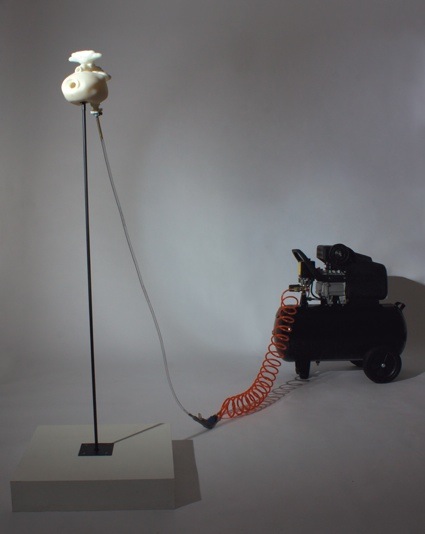
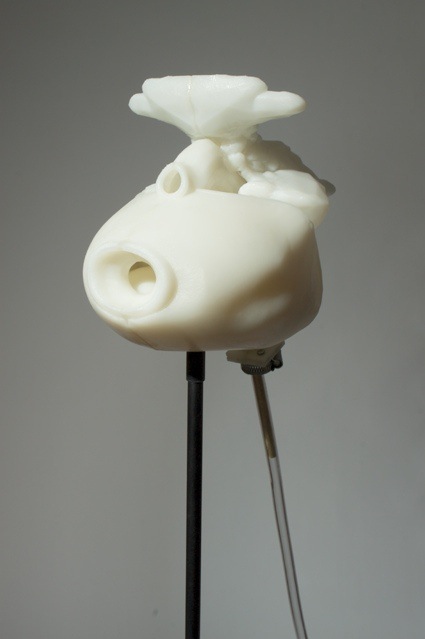
A project by Marguerite Humeau particularly caught my eye.
We-make-money-not-art also picked up on her work and published an interview with here here.
"With BACK, HERE BELOW, FORMIDABLE [ the rebirth of prehistoric creatures ],Marguerite Humeau, attempts to ressuscitate the sound of extinct animals by reconstructing their voicebox (lungs, trachea, larynx + vocal folds, mouth and nose). Made of soft tissue, the vocal tract does not fossilize. The only elements which have been preserved through time are their bones. By comparing them with the larynx CT scans of their closest modern relatives, Humeau hopes to be able to deduce what the vocal organs of the extinct animals looked and sounded like. With the help of a specialist of each animal, the designer plans to remodel the soft tissues of the modern animals on the basis of the bone structure of the extinct one. The structure of the soft tissues will then be printed in 3D."
Visited: Shadow Catchers @ V&A + collections
An exhibition of camera-less photography. As with all V&A temporary exhibitions it was really good but too short! More info here.
Pierre Cordier's work the most. His 'chemigrams' created really exciting patterns. -
Pierre Cordier (b. Brussels, 1933) discovered the 'chemigram' process in 1956. Over many years, he has explored the potential of the chemigram like an experimental scientist.
Working more like a painter or printmaker than a photographer, Cordier replaces the canvas or printing plate with photographic paper. He applies photographic developer to the paper to create dark areas and fixer for lighter tones. Further changes to shape and pattern are made by 'localising' products such as varnish, wax, glue, oil, egg and syrup. These protect the surface of the photographic emulsion or can be incised to create a drawing, graphic motif or written text. Entrancing chemical and physical reactions can then be made by repeatedly dipping the paper in photographic developer and fixer. This method allows him to create images impossible to realise by any other means. The process has become the artwork and his style is his technique.


My dad is a photography teacher and has his own studio and on a recent visit I made some photograms of a collection of clips I own -

Also while I was there my dad showed me a collection of amazing hand-painted glass slides, that he was given, which he believes to be over 100 years old. He has no idea of their origins but they appear to have been taken all over the world including China and India.


Pie Paper

Really enjoying this zine from New Zealand. Mixture of art, design, science. The issue I have is called 'Trace'. More infoformation here - http://www.piepaper.com/

Sunday, February 13, 2011
Here & There
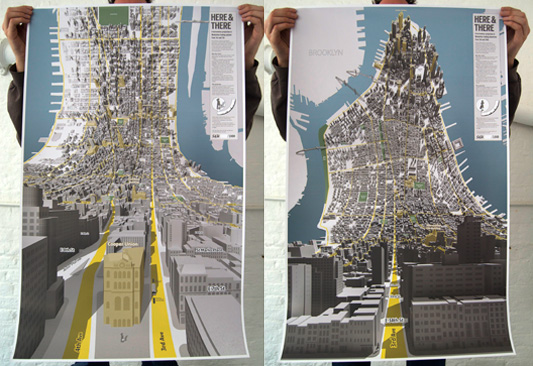
I've previously written about Berg's Here & There maps on this blog. I think they're wicked, but read about the maps influences here and you'll realise how fantastic they really are.
(perspective)
Friday, February 11, 2011
Wednesday, February 9, 2011
Wikipedia for Robots
Robots could soon have an equivalent of the internet and Wikipedia.
European scientists have embarked on a project to let robots share and store what they discover about the world.
Called RoboEarth it will be a place that robots can upload data to when they master a task, and ask for help in carrying out new ones.
Researchers behind it hope it will allow robots to come into service more quickly, armed with a growing library of knowledge about their human masters.
Whole article from the BBC here.
Monday, February 7, 2011
NEWS (!!) - Stamp Collection Found

I secretly love stamps. I have a small collection that my next door neighbour gave me when I was little. Recently discovered again. Amazing graphics. Click to make the picture big.
Elastic Band


Sunday, February 6, 2011
Subscribe to:
Posts (Atom)