Monday, May 14, 2012

Floating Balloon House

This incredible floating house was inspired by Pixar’s animated hit movie Up. National Geographic and a team of scientists, engineers, and balloon pilots teamed up to successfully launch a 16′ X 16′ house 18′ tall with 300 colored weather balloons. Reaching an altitude of over 10,000 feet,  the team set a World Record for the largest balloon cluster flight ever attempted. The flight lasted approximately one hour.


memory, brain, vision


"The images in our mind are extraordinarily rich. We can tell if something is liquid or solid, heavy or light, dead or alive. But the information we work from is poor—a distorted, two-dimensional transmission with entire spots missing. So the mind fills in most of the picture. You can get a sense of this from brain-anatomy studies. If visual sensations were primarily received rather than constructed by the brain, you’d expect that most of the fibres going to the brain’s primary visual cortex would come from the retina. Instead, scientists have found that only twenty per cent do; eighty per cent come downward from regions of the brain governing functions like memory.

Richard Gregory, a prominent British neuropsychologist, estimates that visual perception is more than ninety per cent memory and less than ten per cent sensory nerve signals."

Saturday, May 12, 2012

John Cage, Experimental Music, 1958

"For certain engineering purposes, it is desirable to have as silent a situation as possible. Such a room is called an anechoic chamber, its six walls made of a special material, a room without echoes. I entered one at Harvard University several years ago and I heard two sounds, one high and one low. When I described them to the engineer in charge he informed me that the high one was my nervous system in operation, the low one was my blood in circulation."

from "Chance" Whitechapel Gallery Press


'Sacrilege' Jeremy Deller


Contrasts by Amelie von Oppen


Friday, May 11, 2012

Oulipo


Oulipo (French pronunciation: [ulipo], short for FrenchOuvroir de littérature potentielle; roughly translated: "workshop of potential literature") is a loose gathering of (mainly) French-speaking writers and mathematicians which seeks to create works usingconstrained writing techniques. It was founded in 1960 by Raymond Queneau and François Le Lionnais. Other notable members have included novelists Georges Perec and Italo Calvino, poets Oskar PastiorJean Lescure and poet/mathematician Jacques Roubaud.
The group defines the term littérature potentielle as (rough translation): "the seeking of new structures and patterns which may be used by writers in any way they enjoy."
Constraints are used as a means of triggering ideas and inspiration, most notably Perec's "story-making machine", which he used in the construction of Life: A User's Manual. As well as established techniques, such as lipograms (Perec's novel A Void) andpalindromes, the group devises new techniques, often based on mathematical problems, such as the Knight's Tour of the chess-board and permutations.

The Art of Noises

The Art of Noises (L'arte dei Rumori) is a Futurist manifesto, written by Luigi Russolo in a 1913 letter to friend and Futurist composerFrancesco Balilla Pratella. In it, Russolo argues that the human ear has become accustomed to the speed, energy, and noise of theurban industrial soundscape; furthermore, this new sonic palette requires a new approach to musical instrumentation and composition. He proposes a number of conclusions about how electronics and other technology will allow futurist musicians to "substitute for the limited variety of timbres that the orchestra possesses today the infinite variety of timbres in noises, reproduced with appropriate mechanisms"
http://en.wikipedia.org/wiki/The_Art_of_Noises


Luther Blissett

Luther Blissett is a multiple-use name, an "open reputation" informally adopted and shared by hundreds of artists and activists all over Europe and the Americas since 1994. The pseudo-name first appeared in Bologna, Italy, in mid-1994, when a number of cultural activists began using it for staging a series of urban and media pranks and to experiment with new forms of authorship and identity. From Bologna the multiple-use name spread to other European cities, such as Rome and London, as well as countries such as Germany, Spain, and Slovenia.[1] Sporadic appearances of Luther Blissett have been also noted in Canada, the United States, and Brazil.


The industry of the integrated spectacle and immaterial command owes me money. I will not come to terms with it until I will not have what is owed to me. For all the times I appeared on TV, films, and on the radio as a casual passersby or as an element of the landscape, and my image has not been compensated . . . for all the words or expressions of high communicative impact I have coined in peripheral cafes, squares, street corners, and social centers that became powerful advertising jingles, without seeing a dime; for all the times my name and my personal data have been put at work inside stats, to adjust the demand, refine marketing strategies, increase the productivity of firms to which I could not be more indifferent; for all the advertising I continuously make by wearing branded t-shirts, backpacks, socks, jackets, bathing suits, towels, without my body being remunerated as a commercial billboard; for all of this and much more, the industry of the integrated spectacle owes me money! I understand it may be difficult to calculate how much they owe me as an individual. But this is not necessary at all, because I am Luther Blissett, the multiple and the multiplex. And what the industry of the integrated spectacle owes me, it is owed to the many that I am, and is owed to me because I am many. From this viewpoint, we can agree on a generalized compensation. You will not have peace until I will not have the money! LOTS OF MONEY BECAUSE I AM MANY: CITIZEN INCOME FOR LUTHER BLISSETT![6]
http://en.wikipedia.org/wiki/Luther_Blissett_(nom_de_plume)

EURion constellation

"The EURion constellation is a pattern of symbols incorporated into a number of banknote designs worldwide since about 1996. It is added to help imaging software detect the presence of a banknote in a digital image. Such software can then block the user from reproducing banknotes to prevent counterfeiting using colour photocopiers. "
http://en.wikipedia.org/wiki/EURion_constellation

Tsunehisa Kimura


Jeremy Deller - What is the city but the people?


A work of art for Tube drivers


Jeremy Deller has been working with Tube drivers and operational staff on the Piccadilly line to produce a new work of art – a booklet of quotes entitled What is the city but the people?
The passport-sized booklet will be given to operational staff on the Piccadilly line from February 2009. Drivers and platform staff will be encouraged to use the quotes in their daily communications with customers, building on the rapport that many already have with their customers and helping to enliven millions of journeys by adding an element of unexpected humour.
What is the city but the people? aims to generate a more positive atmosphere during peak times. It also encourages the many voices of the Tube’s staff to re-enter the environment of the network, bringing some of the personalities that have made it famous to the fore once more. Coming from a wide range of philosophical, political and historical sources, the quotes present a thought-provoking rumination on life in the city, especially when heard on the London Underground.
The artwork was introduced to Piccadilly line staff through a series of special book launches hosted by comedian Arthur Smith, well known for his stand-up routines. Smith spent a day travelling with a Piccadilly line driver to experience life behind the scenes on the Tube at first hand, before passing on helpful tips to drivers and station staff on communicating with public audiences.
Deller said: “Originally, when asked to think about a project for London Underground, I suggested a day of no announcements on the Underground, but obviously this was not possible, so I came up with the idea to give staff a collection of quotes and the idea grew from there. I often wish announcements were more personal and reflected the realities and absurdities of living and working in a big city. I think the travelling public enjoy some humour and unexpected insight during their journey.”

White on White, Rufus Corporation


film narrative via algorithm 

Wednesday, May 9, 2012

Hans Ulrich Obrist In Conversation with Adam Curtis, Part II

http://www.e-flux.com/journal/in-conversation-with-adam-curtis-part-ii/

" in an age of subjectivity where everyone lives inside their heads—I mean, how can you have a manifesto? Everyone has their own manifesto now. I think this is the other thing that politicians have come to realize, that in an age where people are obsessed by their feelings and what is inside their own heads, and tend not to look outside themselves and join things like trade unions or political organizations, then power comes from finding out what is inside peoples’ heads, not from encouraging them to look outside. So knowing what they want is the driving force in politics, mostly through focus groups. In the face of that, how can you have a manifesto? Everyone’s head is a manifesto. And politics has got caught up in trying to juggle all those competing individualized manifestos. "


- and lots of other interesting stuff...

Tuesday, May 8, 2012

Lino Printing with Ellie and Hanna


Ellie gave us a lesson on lino printing.


The Eagleman Stag by Mikey Please

EPIC

Sophie Calle Double Game

"At the end of January 1981, on the streets of Paris, I followed a man whom I lost sight of a few minutes later in the crowd. That very evening, quite by chance, he was introduced to me at an opening. During the course of our conversation, he told me he was planning an imminent trip to Venice. I decided to follow him."


--


"In April 1981, at my request, my mother went to a detective agency. She hired them to follow me, to report my daily activities, and to prove photographic evidence of my existence."


--


"I found an address book. I decided to photocopy the contents before sending it back anonymously to its owner. I then contacted those people whose names were noted down and asked them to tell me about the owner. Thus I would get to know this man through his friends, his acquaintances. I would try to discover who he was without ever meeting him and to produce a portrait of him, over an uncertain length of time, that would depend on the willingness of his friends to talk about him and on the turn taken by events."


--


"I saw him for the first time in December 1985, at a lecture he was giving. I found him attractive, but one thing bothered me: he was wearing an ugly tie. The next day I anonymously sent him a thin brown tie. Later, I saw him in a restaurant and he was wearing it. Unfortunately, it clashed with his shirt. It was then that I decided to take on the task of dressing him from head to toe: I would send him one article of clothing every year at Christmas."


--

Motion Efficiency Studies


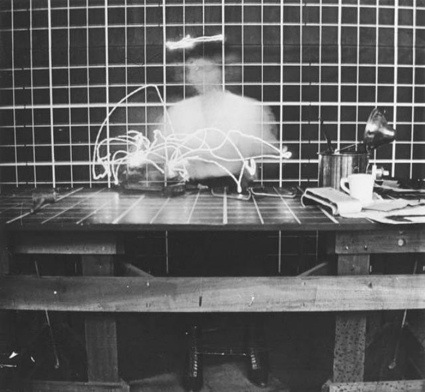
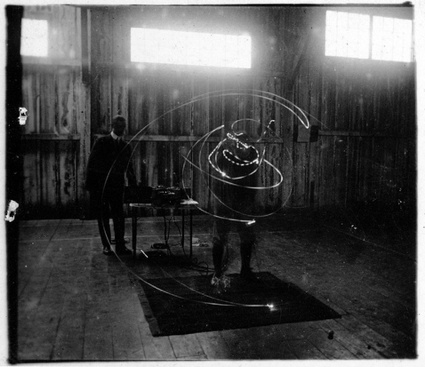
The technique was developed by Frank Gilbreth and his wife, Lillian in the early 20th century to improve work methods. The couple employed time-lapse photography to reduce a complete work cycle to the shortest and most efficient sequence of gestures.
To look for this optimal "relationship of human effort to the volume of work that the effort accomplishes", they attached a camera to a timing device and photographed workers performing various tasks. The motion paths were traced by small lamps fastened to the worker's hands or fingers.
The objective of the research was to minimize arm movement and hence speed and ease manual work. Gilbreth's findings were used in assembly lines but they also found their way into other contexts: Gilbreth was the first to propose that a nurse would assist the surgeon, by handing them surgical instruments as called for. He also devised the standard techniques used around the world to teach army recruits how to rapidly disassemble and reassemble their weapons even when blindfolded.


Monday, May 7, 2012

Croped


CROPS is a stopmotion film on centre pivot irrigation in the USA.
Long water-sprinkler arms rotate around a central pivot, irrigating circular fields of verdant crops in desert or semiarid environments. Often a well, located at the centre of the circle, pumps water up from vast aquifers in the rock formations below, or Rio Grande water is canalized and redirected into the deserts feeding the well. Once the Rio Grande reaches Mexico, it's riverbed has dried.
This trailer was made using 1000 circles cropped in Google Earth.

Labels

Blog Archive