Jitterbug from Ryan McCaffrey on Vimeo.
Monday, February 22, 2010


Friday, February 12, 2010
Visited: Decode @ V&A
I went to the Victoria and Albert Museum last week to see their new exhibition on interactive and digital design called Decode. The pieces were split into three categories called 'code' 'interactivity' and network'. I thought it was a really enjoyable exhibition and you could see that the rest of the visitors were also enjoying it very much. But I suppose much of the work on display was purely to create enjoyment for the people who are interacting with the piece and the others who were watching. A few of the pieces were more about gathering information or data and then presenting this in a interactive way or more visual way.
An exhibition definitely worth visiting. My favourite piece was Weave Mirror by Daniel Rosin. I think I really liked it because it combined digital technology with mechanical actions and it was amazing how much detail it could create in the tones of colours and how quickly it reacted to your movements. You also got a really nice feedback from the sound it produced as you moved back and fourth. See the video below or go give it a go yourself at the V&A. More info on the exhibition here.
"Weave Mirror" (2007) by Daniel Rozin from bitforms gallery nyc on Vimeo.
Monday, February 8, 2010
Visited: RSA
The RSA (the Royal Society for the Encouragement of Arts, Manufacturers and Commerce) put on free talks about all sorts of interesting subjects with leading experts in their field. I've been to two now.
The first was called "The Anatomy of an Action: Self and Responsibility After Neuroscience" and was lead by Professor Patrick Haggard. Some information about the talk (which explains it quite clearly and concisely) -
Benjamin Libet (1916-2007) was a pioneering scientist in the field of human consciousness. His classic experiment showed that when subjects were asked to press a button, prior to their decision to do so, their unconscious brains had already started getting them ready to act. This implies that things happen in the following order: first comes automatic brain activity, then a conscious decision, then the action itself.
These findings seem to challenge our common sense idea of ourselves. ‘We’ seem to be nothing more than conscious decision-makers with the occasional power of veto over unconscious forces.
These findings seem to challenge our common sense idea of ourselves. ‘We’ seem to be nothing more than conscious decision-makers with the occasional power of veto over unconscious forces.
If this is right, does it put in question personal responsibility? Or does it simply shift us to a conception of indirect responsibility? For example, an athlete and her coaches are all indirectly responsible for the reactions of her unconscious brain through the training of habits, skills and intuitive responses. Is all responsibility for action like this? If so, what does this mean for social policy areas such as education and criminal justice?
After an introduction and explanation of the subject it was then debated by two philosophers - A.C. Grayling and Barry Smith. It was extremely interesting and I got the chance to learn about something that I didn't really previously know anything about. I have to admit I didn't understand 100% of what they were saying, especially when they moved onto debating the subject, but for the most part of the talk it was explained in a really clear easy to understand way. You can listen to the talk here
--------------------------------------------------------------------------------------------------------------
The most recent talk I went to was called "The Hidden Wealth of Nations" with David Halpern.
Richer nations are happier, yet economic growth doesn′t increase happiness. This paradox is explained by David Halpern’s new book The Hidden Wealth of Nations – the extent to which citizens get along with each other independently drives both economic growth and well–being.
Much of this hidden wealth is expressed in everyday ways, such as our common values, the way we look after our children and elderly, or whether we trust and help strangers. It is a hidden dimension of inequality, and helps to explain why governments have found it so hard to reduce gaps in society. There are also deep cracks in this hidden wealth, in the form of our rising fears of crime, immigration and terror.
David Halpern visits the RSA to explore what is happening in contemporary societies - from value change to the changing role of governments - and to offer suggestions on what policymakers and citizens can do about it.
Much of this hidden wealth is expressed in everyday ways, such as our common values, the way we look after our children and elderly, or whether we trust and help strangers. It is a hidden dimension of inequality, and helps to explain why governments have found it so hard to reduce gaps in society. There are also deep cracks in this hidden wealth, in the form of our rising fears of crime, immigration and terror.
David Halpern visits the RSA to explore what is happening in contemporary societies - from value change to the changing role of governments - and to offer suggestions on what policymakers and citizens can do about it.
He gave some amazing examples of societies' values and beliefs, how they have changed and how they compare to different countries throughout Europe. He talked about peoples levels of trust and fear. For example more educated people within the UK have higher levels of trust for other people. But our overall level of trust for others is quite low compared to that of other European countries. He talked about the Easterlin Paradox and how Danish people are apparently the most happy in Europe and they place Love as the thing that provides the most happiness. Whereas the people within the UK aren't particularly happy and we place Money as one of the most important things that makes us happy. He made some suggestions for changing the way we measure the wealth of nations so that we focus less on money and GDP and alter it so that is takes into account citizens wellbeing and quality of life. For example measuring complimentary currencies, placing value on the work of volunteers and utilising peoples skills and encouraging them to be exchanged. Watch the recorded talk below.
Friday, February 5, 2010
Dark Clouds by Jürgen Nefzger

golfers tee off in the shadow of Sellafield, England

a fisherman dozes across the river from the reactor at Nogent-sur-Seine

Torness, Scotland

nuclear plant (never used) turned theme park in Kalkar, Germany
100th Monkey Effect

This phenomenon is considered to be due to critical mass. When a limited number of people know something in a new way, it remains the conscious property of only those people. The Hundredth Monkey Syndrome hypothesises that there is a point at which if only one more person tunes in to a new awareness, a field of energy is strengthened so that new awareness is picked up by almost everyone.
The Hundredth Monkey Effect was first introduced by biologist Lyall Watson in his 1980 book, ‘Lifetide.’ He reported that Japanese primatologists, who were studying Macaques monkeys in the wild in the 1950s, had stumbled upon a surprising phenomenon. Some anthropologist were studying the habits of monkeys on some islands in the ocean off the shores of Japan. They found one particularly smart little fellow, and taught it to wash its food before eating it. He learned to do this quite quickly. Soon the other monkeys in his family also began to wash their food before eating it. Later this behavior spread to other monkeys in the clan. About the time one hundred monkeys were washing their food prior to eating it, suddenly all the monkeys on all the islands, some thousands of miles away, began to wash their food before eating it.
This surprising observation became known as the Hundredth Monkey Effect and has been repeatedly observed. This same phenomenon is true in humans as well. It is part of the reason we have trends in fashion, the economy, and politics, etc. When we understand this concept, it becomes very important for us to develop our positive thinking. Humanity will be free, free at last. Free to build a better world, by "giving" - from the immense power of love, instead of "taking" - from the energy of fear.
The Hundredth Monkey Effect was first introduced by biologist Lyall Watson in his 1980 book, ‘Lifetide.’ He reported that Japanese primatologists, who were studying Macaques monkeys in the wild in the 1950s, had stumbled upon a surprising phenomenon. Some anthropologist were studying the habits of monkeys on some islands in the ocean off the shores of Japan. They found one particularly smart little fellow, and taught it to wash its food before eating it. He learned to do this quite quickly. Soon the other monkeys in his family also began to wash their food before eating it. Later this behavior spread to other monkeys in the clan. About the time one hundred monkeys were washing their food prior to eating it, suddenly all the monkeys on all the islands, some thousands of miles away, began to wash their food before eating it.
This surprising observation became known as the Hundredth Monkey Effect and has been repeatedly observed. This same phenomenon is true in humans as well. It is part of the reason we have trends in fashion, the economy, and politics, etc. When we understand this concept, it becomes very important for us to develop our positive thinking. Humanity will be free, free at last. Free to build a better world, by "giving" - from the immense power of love, instead of "taking" - from the energy of fear.
From Michael Paukner's Flickr which also has some really nice graphic design by him.
Google Goggles
Another amazing application from Google.
My friend Owen was telling me about this the other day and I was just looking at Think Public's Blog and a saw a video for it.
Wednesday, February 3, 2010
The Frontal Cortex: Power
A very interesting article about the behaviour of people in a position of power. Read the full article by Jonah Lehrer HERE
Tuesday, February 2, 2010
best short film ever
I was just reminded of this video by Charles and Ray Eames. It's mind blowing. I don't think I'll ever get bored of watching it.
Monday, February 1, 2010
Google Insights

Statistics and information on web searches.
Click the image to make it a bit bigger but have a look Google Insights yourself here
Information is beautiful
How green is your pet?

Information is Beautiful is excellent. Click to see many more information visualisations.
Sunday, January 31, 2010
Stefan Sagmeister: The power of time off
I've always thought that it's important to make time for things other than work and that taking time out (that could be 5 minutes to 5 months?) from projects and then coming back to them can be very beneficial. Sitting at a desk, starring at a computer screen doesn't particularly help generate ideas or solve problems. While at Uni I often found that the moment I left the studio was when ideas started to fill my head. Also, I think having separated work time and 'play' time actually makes me work more effectively and efficiently. I think it's important to see and experience many different things in order to inform and inspire me, so in some ways activities other than work are equally as important.
I often use this blog to keep track of ideas, thoughts and interesting things I've found while I was actually looking for something else (usually related to the work I should in fact be doing!) But I feel it's important to keep a record of these other, un-related to work, interests and thoughts because they can help provide information for future work and ideas.
This TED video talks about how Stefan Sagmeister makes everyone in his studio take a year long sabbatical every 7 years and the benefits to his employees of this. Ultimately he describes how happy employees are productive employees!
Saturday, January 30, 2010

Sunday, January 24, 2010
TV = generally quite shit
BUT yesterday caught Kevin McCloud's 'Slumming It' on Channel 4. A really fascinating program about life in the slums in India, where even though there are many bad things about living there, such as poor sanitation, the developed world can actually learn a lot about the way they live and how their communities operate. For example, they manage to recycle a very impressive 80% of the waste they produce compared to about 20% in the UK (although you will see their motivations for doing it are very different). Definitely recommend watching it, a very eye opening program.


Been thinking about -
Downshifting
I feel I already live my life, almost, in this way but I didn't realise there was a term for it! After reading about it and learning more I've found out other ways to make more efforts to downshift and been thinking maybe I should implement them into how I live.
Tuesday, January 19, 2010
NEWS - GeoVation
My Idea -
Who used to live in your house? How has your community changed over the years? What was it like to live in your town during the war? What do you think of the area where you live?
Oral history is the recording, preservation and interpretation of historical information, based on the personal experiences and opinions of the speaker.
This 'Mapping Oral History' venture would be an innovative, interactive, website that utilises digital mapping, such as google maps or similar, where users can tag locations and leave recorded (preferably as audio but written if not possible) messages / memories / stories about that area.
It is intended that this website would allow people to give a personal view of the places they have lived and been, building both a current and historical perspective, that can be preserved and then heard by other people and future generations.
Concept image below. Click to see it big.

NEWS - Citizens Advice Bureau project round up
Just before Christmas I finished an eight week research project for the Citizens Advice Bureaux based down in Surrey. I was asked by them to investigate and devise ways that they could diversify their service in order to reach more people within the community but at the same time generate extra income from this to enable the charity to become more financially stable.
I really enjoyed this project. It gave me the chance to use my skills that I have developed as a product designer but apply them to a completely new situation. I went through the same process that I normally would when designing a product but instead of having a tangible outcome I designed services and strategies. I'm really keen to do more work like this, especially in multidisciplinary groups, where people bring their skills together to solve problems out of their normal area of work. I believe it is defiantly a beneficial way of working.
While I was at the CAB I took in an incredible amount of information and learnt so much. It was all really interesting. I also came to realise that the Citizens Advice Bureau is a really under-valued and under-appreciated charity. The volunteers who work there put in a great deal of free time, effort and hard work to give help and advice to anyone who asks for it, no matter who they are and what their situation is. The volunteers contribution to the CAB is estimated to be worth around £730,000 per annum in Waverley alone. (Waverley consists of Farnham, Godalming, Haslemere and Cranleigh - towns within Surrey).
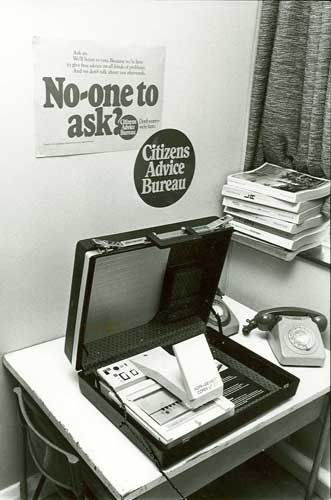
CAB 1980's styleee. The CAB celebrated it's 70th anniversary during 2009.
Visited: Wellcome Collection
This was quite a while ago now but I went to the Wellcome Collection, in Euston, to see their new exhibition on identity. It profiled the lives of nine different people in different rooms within their gallery space. I found it really interesting especially as it coincided with a time that I was thinking about identity quite a lot - How I see myself compared with how other people see me, How I think I look in my head compared with how I actually look, How I see other people and how these views are built etc.
I didn't really like how they had built the exhibition. The rooms that they had made looked a bit un-finished and didn't really look right in the space but the actual exhibition was really good and I would recommend it. More information here.
-----------------------------------------------------------------------------------------------------------------
While I was there I also went to one of the Wellcome Collection 'packed lunch' talks with Rachel Armstrong - a synthetic biologist working at the Bartlett School of Architecture. Her talk was about connecting the natural world with the built environment to create 'living materials' that can grow themselves and may even be a solution to climate change. She also talked quite a bit about people from diverse and different working backgrounds coming together to collaborate on projects and solve problems. For example although she is a biologist she works with architecture students and is also involved with performance art, which I thought was really interesting.
It was a really fascinating talk but unfortunately because it was only about 45 minutes long there wasn't really the chance for her to discuss the issues in detail. But there are some of her talks on TED.com (she is a TED fellow) which I've been watching to find out more-
Listen to a podcast of the actual Packed Lunch talk by Rachel Armstrong here.

Monday, January 18, 2010
Sunday, January 17, 2010
Looks like silly putty

Sugru is a simple silicone substance that makes it easy to alter, add to and repair stuff. Invented by RCA graduate Jane ní Dhulchaointigh, the material allows people to “hack” design. Pretty Exciting.
Read more at IconEye
Saturday, January 2, 2010
I should be sleeping.
I wish I was, but I can't. I've managed to really mess up my sleep patterns from too many late nights over the holiday season.

Looking downtown from 3rd and 35th, New York
'Here and There' for BERG by James King
Saturday, December 5, 2009


NEWS - onedotzero_adventures in motion 2009 highlights
From the summer, it features some footage from the Cascade_09 project -
Wednesday, December 2, 2009
I'm supposed to be writing about social enterprises
But instead I'm looking at
'My parents were awesome'
and imagining if those people actually were my parents!
'My parents were awesome'
and imagining if those people actually were my parents!
Tuesday, December 1, 2009
Father Christmas please bring me these!

Herman Miller Select Walnut Spinning Tops. More info here
Somehow I think I won't be getting them though. They are limited edition and retail for around $200 I think.
Subscribe to:
Posts (Atom)