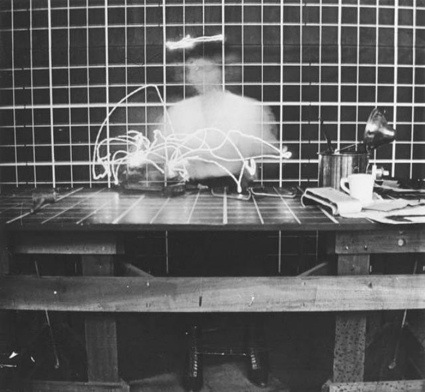
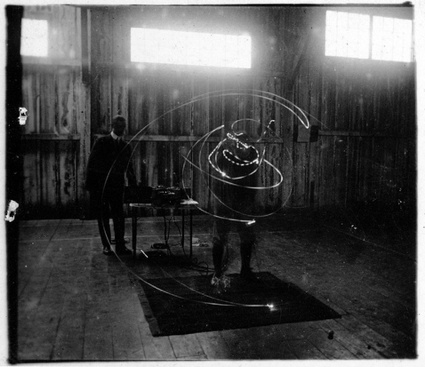
The technique was developed by Frank Gilbreth and his wife, Lillian in the early 20th century to improve work methods. The couple employed time-lapse photography to reduce a complete work cycle to the shortest and most efficient sequence of gestures.
To look for this optimal "relationship of human effort to the volume of work that the effort accomplishes", they attached a camera to a timing device and photographed workers performing various tasks. The motion paths were traced by small lamps fastened to the worker's hands or fingers.
The objective of the research was to minimize arm movement and hence speed and ease manual work. Gilbreth's findings were used in assembly lines but they also found their way into other contexts: Gilbreth was the first to propose that a nurse would assist the surgeon, by handing them surgical instruments as called for. He also devised the standard techniques used around the world to teach army recruits how to rapidly disassemble and reassemble their weapons even when blindfolded.
No comments:
Post a Comment