For the Cally Festival we had postcards printed of Caledonian road for people to take home with them. The were kindly printed by Dodd's on King's Cross Road.
 Entrance to the festival. Mario came with 100's of plants!
 Street buskers and a juggling granny!
 Music stage
 Beginnings of the mural on the side of RSPCA shop
 This disused shop became a pop-up gallery.
 Miles and miles of bunting and flags outside the Cally Festival HQ shop.
On the other hand nearly everyone (young and old) showed a similar relationship between colour and sound, where lower notes are thought to be best represented as dark blue and higher notes as bright yellow.
In other words people seem to have internal mental maps between colour and other perceptual qualities, such as sound and form. Amazing when these relationships do not exist in nature.
.........
"In another experiment we asked people to put 49 coloured blocks on a surface area of 49 spaces. They had no other instruction.
The number of possible images that could have been created was 10 raised to the power of 62 - a huge number.
What's remarkable is that people made patterns that were largely predictable, because everyone grouped colours together according to similarity. Why?
Because we have an inherent need for structure, and in particular structures that are familiar, in this case structures that are similar to the mathematics of the images of nature.
In yet another experiment that really looked at the fundamentals of colour vision, we asked whether there might be individual differences in simply detecting light.
What we discovered is that not only are women more sensitive than men, but also women who feel they have a stronger sense of control are significantly better than those women who feel powerless.
Remarkable really when one remembers that we're just talking about light detection.
We also examined whether colour can actually alter our sense of a minute.
Our initial observations suggested that a minute takes longer for men than for women… about 11 seconds longer on average.
But a minute took longer for men and women when surrounded by red light, as compared to blue light.
This effect is likely to be linked to arousal since it is well-known that red and blue create different states of arousal in men and women alike."
Living longer is one thing, but the quality of the extra years is what counts, he believes. And no-one knows if these extra years will be spent working for longer and being mentally and physically active, or finding oneself frail and bed-ridden.
"We may not be able to expect people to work much longer than they already are," Read warns. "If the productive years remain about the same but the lifespan expands that becomes a major issue for society."
The novelist Martin Amis argued last year that the answer might be "euthanasia booths on every street corner". As he explained at a public Q&A session the swelling ranks of the elderly would not only be a drain on resources for younger generations, but lead to an undignified end to one's life.
......
"The progress has been astonishing," he notes. For the last 50 or so years life expectancy has been increasing at a rate of six hours a day."
Another student favored cultivating a fungus to destroy some of the plastics that are threateningto clog up landfill sites for centuries to come. The fungus, or so his theory went, would “eat” the plastic and purify any toxic remains."

Using anything from elaborate robotics and slick product design, to experimental scientific procedures and prosthetics, the artists and designers engaged in this field destabilise distinctions between mind and body, and blur boundaries between organic and artificial, internal and external, and public and private. And indeed, between fiction and fact.
Whether hi-tech or lo-fi, this work deals with human emotions and senses. Ranging from the practical to the fantastic and absurd, the futuristic projections of this cross-section of designers and artists whose practices envision new ways of relating to and experiencing the world around us provide glimpses of strange new tomorrows in which humans and technology coexist - often within the same body.
The exhibition looks at the material spatially, from the body outwards to three-dimensional space. Exhibits in which body and device become one, or are so closely linked as to be almost indistinguishable from one another, are shown alongside those that, in some way, impact upon the space around us. Others that examine how we engage with our immediate suuroundings and how we interact are exhibited side-by-side with those that play without senses and feelings, sometimes enhancing—sometimes disorientating—our perceptions.
Simultaneously playful and incisive, these propositions inevitably produce more questions than answers, inviting critical dialogue on issues such as bioethics, simulated reality, post-humanism and genetic modification. Artists and designers in this field constantly push boundaries, sometimes working at the edges of conventional respectability, challenging our most basic assumptions about our own bodies and minds.
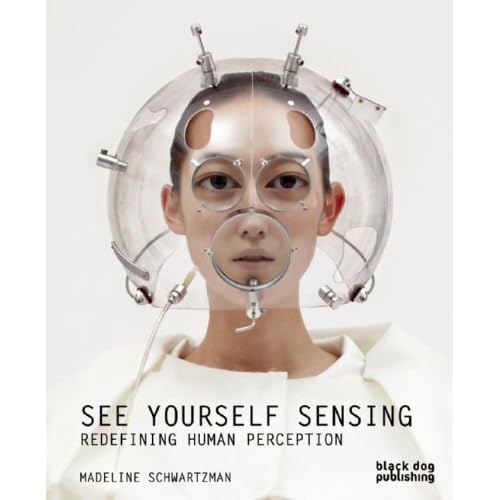
Curated by Marianne Templeton and Kate Trant, See Yourself Sensing: Redefining Human Perception has been developed in conjunction with the publication of the same name, authored by Madeline Schwartzman, and released in June 2011 by Black Dog Publishing."
From here.
I also bought the book which is really cool.


Masamichi Souzou is a New Kind of Company. We solve for human happiness.
In a world where everything is connected, there no system, activity, or interaction, that falls outside our purview. And through the appropriate consideration of every part of this beautifully complex world we work to optimize for human happiness.
Masamichi Souzou from J. Paul Neeley on Vimeo.
http://www.masamichisouzou.com/index.php
Masamichi Souzou: Everything Considered
"For the past six months, J. Paul Neeley has been tinkering with the many variables of his daily life - from sleeping patterns, to exercise regime and diet - in an attempt to optimize his happiness. Having removed seating from his life almost entirely in the process, J. Paul walks well over 10km a day whilst working atop a treadmill. His concept "Masamichi Souzou" proposes to offer such happiness optimisation as a service."


When you have absorbed these lessons in urban history, it is time to take a few minutes to watch Wentworth's videos. These sound un-watchable but are actually well made and don't last long. One simply follows a plane as it leaves a vapour trail in the sky above King's Cross Station; another wittily documents the deft artistry of workmen from the highways department painting road markings.
In these films Wentworth metaphorically states the theme of the show: that London is a kind of blank sheet on which everyone is writing, all of the time. Every generation leaves its mark on the living, changing city. We make it our own.
Wentworth's installation for Artangel will mimic this process. What I saw on the day of the opening is just the basic structure of a work that will change and grow from day to day as more and more material is added to it.
To ensure that the display doesn't become museumy and moribund, Wentworth has set up a half a dozen ping pong tables and announced the first King's Cross table tennis tournament. Anyone can drop by at any time of the day and pick up a game. For the next few months at least, General Plumbing Supplies will function like a neighbourhood social club.
Thanks to Wentworth's engaging, humorous take on everything he touches, the show is hugely entertaining - so much so that I forgot to ask myself what it all had to do with art. Then, after I'd left the show and stepped out into York Way, I realised that the work of art wasn't to be found on the premises of General Plumbing Supplies, but in the streets around me.
As I walked back to my car, I noticed the Italianate villa from which taxis are despatched at the side of King's Cross station. I stopped to read faded signs for shops that vanished long ago, and peered into old-fashioned cafes cheerfully dishing up the kind of food the Brussels health police will soon make it a criminal offence to serve.
Above your head you see planes you hadn't noticed before, and at your feet you become alert to the sheer complexity of road markings we spend our whole lives obeying, and yet never really see.
Wentworth's genius is to make us see the world from the fresh and original perspectives that he does, and to make us aware that, if London is a living city, it is simultaneously a dying one. Places we have known all our lives will become a memory in 10 years' time."
Full article here - http://www.telegraph.co.uk/culture/3582251/View-of-streets-we-never-see.html


Our culture no longer belongs to us.
The way we produce and share our culture is as important as the outcome.
In a system where it is too expensive to stitch your own clothes, we answer to the big producers whose practices we are increasingly at odds with.
Don't reject culture. Reclaim it!
To hell with trade secrets and copyright. We're taking back what is ours and we're sharing it with everyone.
'Who owns culture?'
henryflitton@hotmail.com
http://www.reclaimingculture.com
 ??
??The moon life foundation - Alicia Framis
Director of Moon Life Foundation, Alicia Framis speculates on the possibility that humans will live in space in the future. The project acts as a stimulus for artists, designers, architects to create futuristic radical political but humane concepts for an extreme lunar environment.
Alicia Framis is also the Lost Astronaut – an performance-installation at APF LAB, exploring the potentialities of living on the moon through the ironical activities and fictional character of a woman astronaut. Left on earth like all women who were never part of the moon race, she settles in to BaseCamp, in which she lived for the two weeks in a customized astronaut suit, among drawings and prototypes that aim to both parody and demand women’s presence on the moon.
Alicia Framis studied Fine Arts at the Barcelona University and Ecole de Beaux Arts in Paris. She completed her masters at the Institut d’Hautes Etudes, Paris and at the Rijksakademie Van Beelde Kunstende, Amsterdam.
Who Owns Outer Space? - Dr Jill Stuart
While the 'Martians Chronicles' might soon become real facts, Dr Jill Stuart will be discussing with us the ownership of space, so that we know where to land! She will explain us the history of cosmic governance and the future of outer space law.
Dr Jill Stuart is Fellow in Global Politics at the London School of Economics, and reviews editor for the journal Global Policy. She researches law, politics and theory of outer space exploration and exploitation. Her interests extend to the way terrestrial politics and conceptualisations such as sovereignty are projected into outer space, and how outer space potentially plays a role in reconstituting how those politics and conceptualisations are understood in terrestrial politics.
On observatories and observing - Jem Finer
Come along and meet with one of our space genies, Jem Finer who experienced zero gravity and realized a 1000-year long musical composition (Longplayer), as well as being artist in residence in the astrophysics department at Oxford University making a number of works including two sculptural observatories, Landscope and The Centre of the Universe.
The 'Gravitational Theater'- Julijonas Urbonas
Julijonas will talk about unique aesthetic manifestations of gravity in our highly technologised culture, from anti-gravitational shoes to deadly roller coasters.
Having worked in amusement park development – as an architect, ride designer and head of fairground – Urbonas became fascinated by what he calls the bodily-perceived aesthetics of ‘gravitational theatre’. Since then the topic has been at the core of his creative life, from artistic work to scholarly articles. Most recently this interest has matured into his PhD research based in the department of Design Interactions at the RCA.
The series is programmed by Nelly Ben Hayoun and Nahum Mantra.
KOSMICA is endorsed by ITACCUS, the International Astronautical Federation's Committee on the Cultural Utilisation of Space.
Julijonas Urbonas - http://www.julijonasurbonas.lt
Dr Jill Stuart - lse.ac.uk, www.globalpolicyjournal.com
Jem Finer - www.cosmolog.org.uk, www.onearthasinheaven.net,longplayer.org
Alicia Framis - http://moon-life.org/, www.aliciaframis.com